
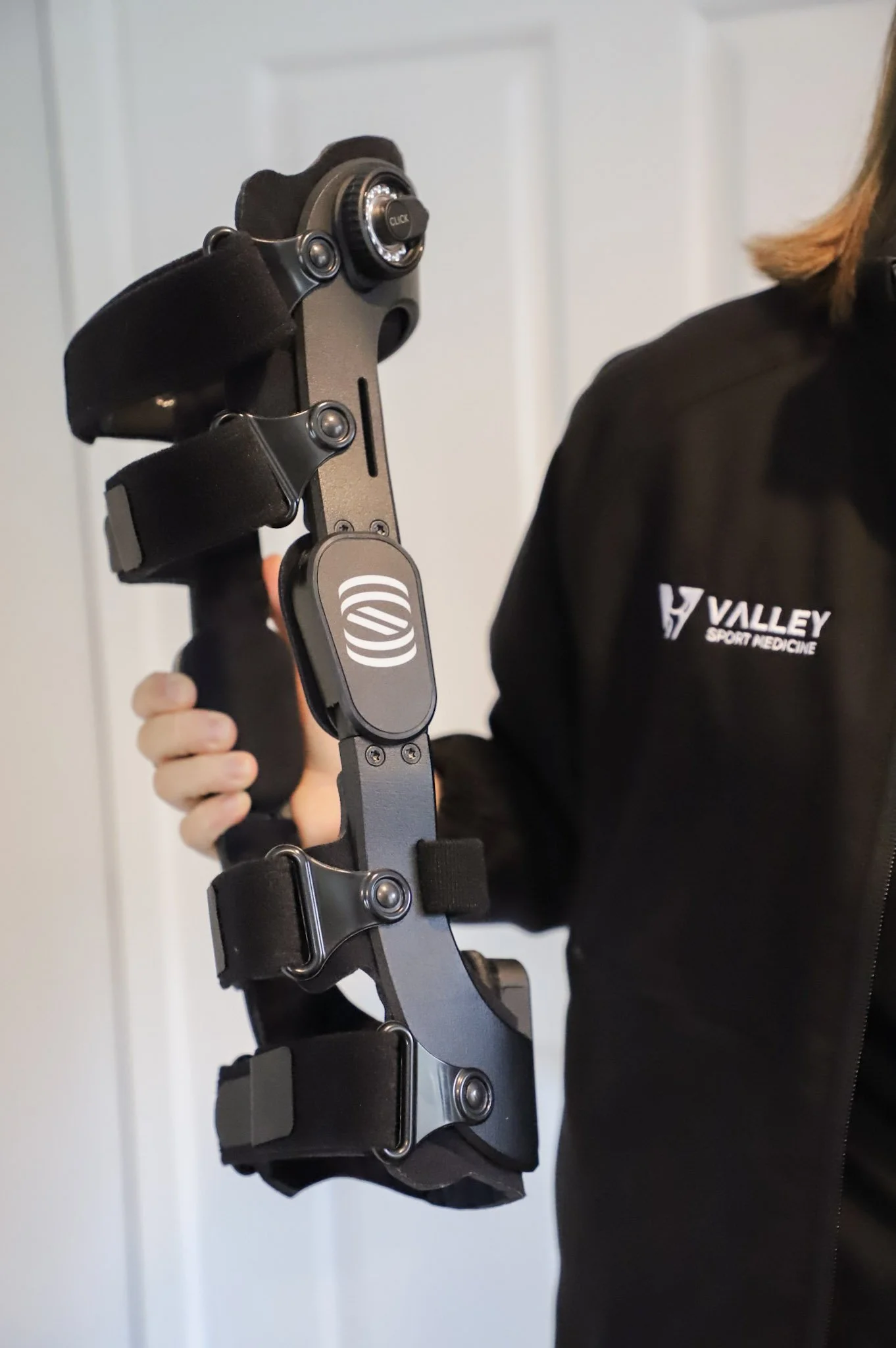
If you live with knee osteoarthritis (OA), you have probably wondered whether a knee brace could ease your pain and help you stay active. It is one of the most common questions we hear at Valley Sport Medicine. The short answer is that the right brace can help many people — but it works best as one part of a bigger plan, not as a cure on its own. Here is what the current evidence tells us.
What is knee osteoarthritis?
Osteoarthritis is the gradual wearing down of the smooth cartilage that cushions your knee joint. As the cushioning thins, the bones carry more load, which can lead to pain, stiffness and swelling. OA often affects the inner (medial) side of the knee more than the outer side. This can be made worse by a slightly bow-legged ("varus") alignment, which pushes extra weight through the inner part of the joint.
How can a knee brace help?
Braces work in two main ways, and it helps to know which type you are being offered.
Unloader (valgus) braces. These are hinged braces with a lever system that gently shifts weight away from the worn part of the joint. By redirecting load off the painful inner compartment, they can reduce pain and improve how well the knee works (Ault et al., VA/DoD Clinical Practice Guideline, 2026). In one randomized trial, people with medial knee OA who added an unloader brace to usual care had clearly greater pain relief and better function after six weeks than those who used usual care alone (Thoumie et al., Scientific Reports, 2018). A one-year Canadian-style trial of a custom unloader brace found lasting improvements in pain, function and quality of life, along with less need for pain medication (Gueugnon et al., Osteoarthritis and Cartilage, 2021).
Soft braces and sleeves. These are stretchy, non-hinged supports. They do not realign the knee, but they provide mild compression and help your brain sense the position of the joint, which can improve comfort and confidence. Reviews show soft braces can meaningfully reduce pain and modestly improve function for up to several months (Ault et al., VA/DoD Clinical Practice Guideline, 2026).
There are also patellofemoral braces designed for OA at the front of the knee (under the kneecap), which may help pain in that specific area.
What do the guidelines say?
Major guidelines generally support bracing as a reasonable option. The American College of Rheumatology strongly recommends tibiofemoral (side-to-side) bracing for knee OA and conditionally recommends patellofemoral bracing (Kolasinski et al., Arthritis & Rheumatology, 2020). The American Academy of Orthopaedic Surgeons also supports bracing to improve symptoms, while noting that results vary from person to person (AAOS Clinical Practice Guideline, 2021).
It is worth being honest about the limits of the evidence. Studies use many different braces and designs, so experts cannot say one specific brace is best, and the quality of some research is modest. A large 2026 trial found that adding a brace to advice and exercise gave small extra benefits in pain and daily activities at three and six months, but these faded by one year — and the people who benefited most were those who wore their brace consistently (Holden et al., BMJ, 2026).
Who tends to benefit most?
Braces are most likely to help if you:
Have OA mainly in one compartment of the knee (often the inner side)
Notice pain mostly with walking, standing or activity
Want to delay or avoid surgery, or stay active while managing symptoms
Are willing to wear the brace regularly — consistency matters
What to keep in mind
Braces are generally safe, but minor issues are common. These can include the brace slipping, skin irritation, warmth or sweating, and occasional swelling if the fit is poor. Unloader braces cost more than simple sleeves and usually need professional fitting, sometimes with adjustments over time, to work properly and stay comfortable.
A brace works best alongside the core treatments proven to help OA. These include:
Regular exercise and strengthening — one of the most effective treatments for OA pain and function
Weight management, if appropriate, to reduce load on the joint
Education and self-management strategies
A cane or walking aid when helpful
Topical or oral anti-inflammatory medication, when suitable for you
Think of a brace as a helpful tool that makes it easier to move, exercise and do the things you enjoy — not a replacement for them (Kolasinski et al., Arthritis & Rheumatology, 2020).
The bottom line
A knee brace can be a valuable part of managing knee osteoarthritis, especially an unloader brace for OA on one side of the joint. The benefits are real but tend to be modest, and they are greatest when the brace fits well, is worn consistently, and is combined with exercise and other proven treatments. The best choice depends on where your OA is, how your knee is aligned, and your own goals.
Talk to us
If you are wondering whether a knee brace is right for you, the team at Valley Sport Medicine in Wolfville would be glad to help. We can assess your knee, discuss your goals, and recommend a plan — including the right type of brace and proper fitting — tailored to you. Contact our clinic to book an appointment.
Prepared with assistance from OpenEvidence and reviewed by Alex Thomas, MD, CCFP (SEM), Dip. Sport Med.
References
1. Ault J, Guevara J, Bair M, et al. The Non-Surgical Management of Hip & Knee Osteoarthritis. VA/DoD Clinical Practice Guideline, 2026.
2. Thoumie P, Marty M, Avouac B, et al. Effect of unloading brace treatment on pain and function in patients with symptomatic knee osteoarthritis: the ROTOR randomized clinical trial. Scientific Reports, 2018.
3. Gueugnon M, Fournel I, Soilly AL, et al. Effectiveness, Safety, and Cost-Utility of a Knee Brace in Medial Knee Osteoarthritis: The ERGONOMIE Randomized Controlled Trial. Osteoarthritis and Cartilage, 2021.
4. Kolasinski SL, Neogi T, Hochberg MC, et al. 2019 American College of Rheumatology/Arthritis Foundation Guideline for the Management of Osteoarthritis of the Hand, Hip, and Knee. Arthritis & Rheumatology, 2020.
5. Management of Osteoarthritis of the Knee (Non-Arthroplasty): Evidence-Based Clinical Practice Guideline. American Academy of Orthopaedic Surgeons, 2021.
6. Holden MA, Nicholls E, Abdali Z, et al. Provision of knee bracing for knee osteoarthritis (PROP OA): multicentre, parallel group, superiority, randomised controlled trial. BMJ, 2026.
