Knee osteoarthritis is one of the most common reasons people develop ongoing knee pain, stiffness and trouble getting around. When exercise, weight management, activity changes and oral medications are not enough, many patients ask about injections. At Valley Sport Medicine in Wolfville, we are often asked which injection is "best." The honest answer is that each option works differently, and the right choice depends on your knee, your goals and your stage of arthritis.
Here is a plain-language overview of the four injections patients ask about most: cortisone, hyaluronic acid, platelet-rich plasma (PRP) and Arthrosamid.
First, the foundation
No injection cures arthritis or regrows a worn-out joint. Injections are tools to reduce pain and improve function so you can stay active. They work best alongside the basics that have the strongest evidence of all: regular exercise, strengthening the muscles around the knee, and maintaining a healthy weight. Think of injections as a helpful add-on, not a replacement for these core treatments.
Cortisone (corticosteroid) injections
Cortisone is a powerful anti-inflammatory medication injected directly into the joint. It is the most reliable option for quick relief of a painful, swollen knee.
What to expect: Pain relief usually starts within days and is strongest in the first few weeks.
How long it lasts: The benefit typically fades after about 4 to 12 weeks, after which the knee often returns to how it felt before.
Good to know: Cortisone is useful for flare-ups or to get you comfortable before an important event, like a trip or a wedding. Repeated injections are generally not recommended, as frequent, long-term use (for example, every three months for years) may accelerate cartilage loss.
Cortisone is inexpensive, widely available and well understood, which is why it remains a mainstay of care.
Hyaluronic acid (viscosupplementation)
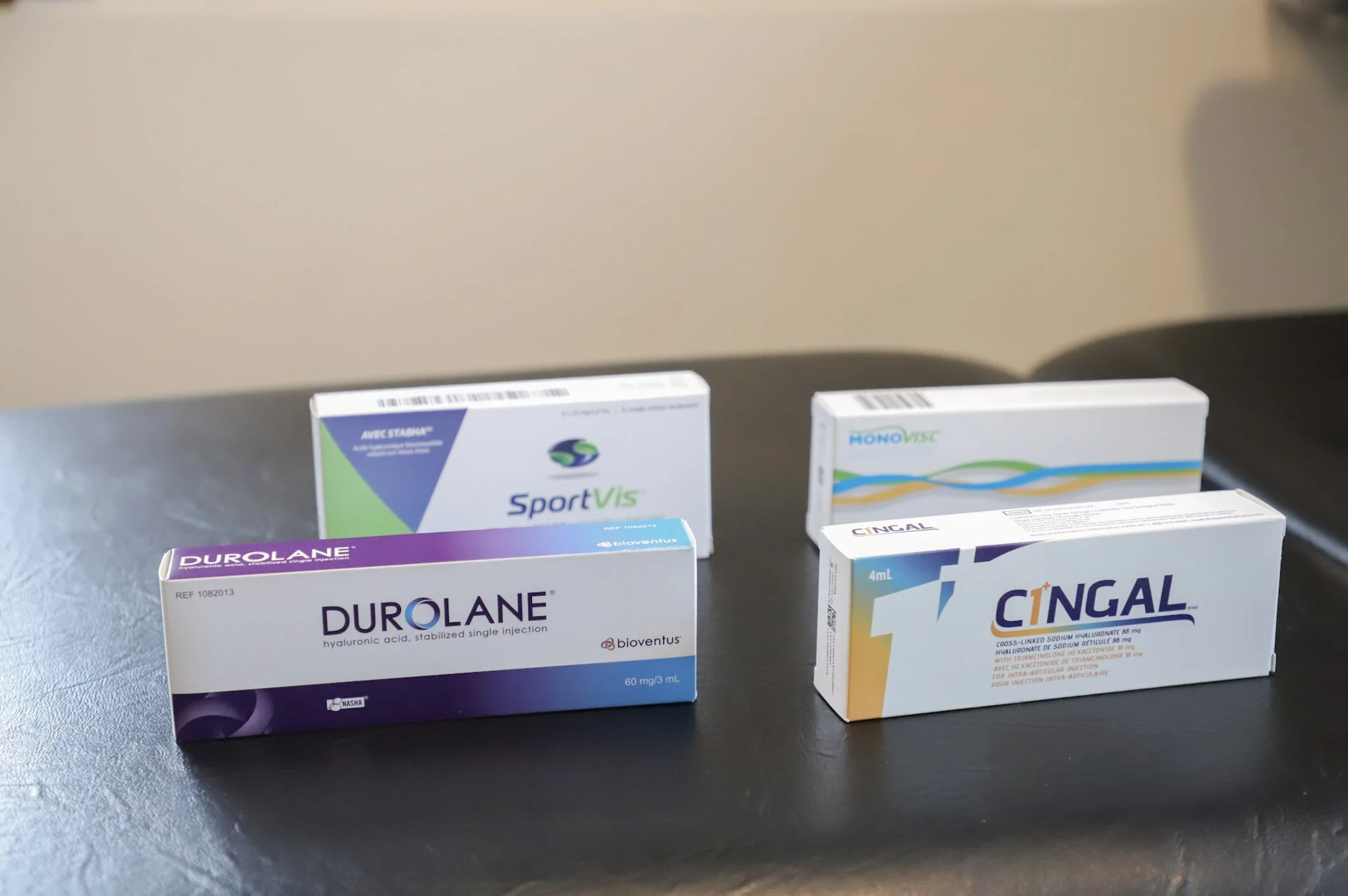
Hyaluronic acid is a gel-like substance naturally found in joint fluid. The injection aims to lubricate and cushion the joint. It is sometimes given as a single shot or as a series.
What to expect: Relief, when it occurs, tends to build gradually over weeks rather than days.
How long it lasts: Some patients report benefit lasting several months.
Good to know: The evidence here is genuinely mixed. Some high-quality reviews support a real symptom benefit, while other large analyses find the average benefit is small and may not be noticeable to most people. For this reason, several major guidelines do not routinely recommend it, though many patients and clinicians still find it worthwhile to try.
Hyaluronic acid may suit people with mild-to-moderate arthritis who want to avoid or delay other steps.
Platelet-rich plasma (PRP)
PRP uses your own blood. A small sample is drawn, spun in a centrifuge to concentrate the platelets and growth factors, and the concentrate is injected into the knee. The idea is to calm inflammation and support the joint environment.
What to expect: Benefit, if it comes, develops over weeks.
How long it lasts: Several comparison studies rank PRP among the better options for pain and function at six months and beyond, often ahead of cortisone and hyaluronic acid.
Good to know: The results are not consistent. A well-designed trial found PRP was no better than a saline (placebo) injection at one year. PRP preparations also vary widely between clinics, which makes outcomes harder to predict. PRP is generally not covered by provincial health plans and is paid out of pocket.
PRP tends to appeal to more active patients with earlier-stage arthritis who want to try a biologic option.
Arthrosamid (polyacrylamide hydrogel)
Arthrosamid is a newer option. It is a water-based gel (about 97.5% water and 2.5% polyacrylamide) given as a single injection. Unlike the other treatments, the gel is not absorbed by the body; instead it becomes integrated into the joint lining, which may explain its longer-lasting effect.
What to expect: A single injection, with benefit developing over the following weeks.
How long it lasts: This is the most interesting feature. Follow-up studies of a single injection report meaningful pain relief sustained at three years and even five years in those who were followed.
Good to know: In head-to-head research, Arthrosamid performed about as well as hyaluronic acid and showed a modest edge over cortisone at six months. Side effects were usually mild, most often temporary pain or swelling after the injection. The main limitation is that it is new; there is less long-term, high-quality evidence than for older treatments, and it is a private-pay option.
Arthrosamid may interest patients with moderate-to-severe arthritis looking for a longer-lasting, non-surgical option, particularly those hoping to delay knee replacement.
So which one is right for you?
There is no single winner for everyone. A reasonable way to think about it:
Need relief fast, or managing a flare? Cortisone.
Want to try a lubricating gel for mild-to-moderate arthritis? Hyaluronic acid.
Active, earlier-stage, open to a biologic option? PRP.
Looking for a longer-lasting single injection? Arthrosamid.
Cost, coverage, how often you are willing to repeat treatment, and the stage of your arthritis all matter. The best decision is made together with a clinician who has examined your knee and reviewed your imaging.
Talk with us
If you are living with knee arthritis and wondering which injection might help, the team at Valley Sport Medicine in Wolfville would be glad to review your options and build a plan that fits your goals. Please contact our clinic to book an assessment.
Prepared with assistance from OpenEvidence and reviewed by Alex Thomas, MD, CCFP (SEM), Dip. Sport Med.
References
Sharma L. Osteoarthritis of the Knee. New England Journal of Medicine. 2021.
Pereira TV, et al. Viscosupplementation for Knee Osteoarthritis: Systematic Review and Meta-Analysis. BMJ. 2022.
Felson DT. Intra-articular Corticosteroids and Knee Osteoarthritis. JAMA. 2016.
Jawanda H, et al. PRP, Bone Marrow Aspirate Concentrate, and Hyaluronic Acid Injections Outperform Corticosteroids. Arthroscopy. 2024.
Bruyère O, et al. Effects of Intra-Articular Hyaluronic Acid Injections on Pain and Function in Knee Osteoarthritis: An Umbrella Review. Maturitas. 2025.
Bennell KL, et al. Effect of Intra-articular Platelet-Rich Plasma vs Placebo Injection: The RESTORE Randomized Clinical Trial. JAMA. 2021.
Bensa A, et al. PRP Injections for the Treatment of Knee Osteoarthritis: A Meta-analysis of Randomized Controlled Trials. American Journal of Sports Medicine. 2025.
Bliddal H, et al. Polyacrylamide Gel Versus Hyaluronic Acid for Knee Osteoarthritis: A Randomised Controlled Study. Clinical and Experimental Rheumatology. 2024.
Bliddal H, et al. Sustained Symptom Relief and Safety Over Five Years Following a Single Injection of 2.5% Polyacrylamide Hydrogel. Clinical and Experimental Rheumatology. 2026.
Aykaç B, et al. Comparative Efficacy of Polyacrylamide Hydrogel Versus Hyaluronic Acid and Corticosteroids in Knee Osteoarthritis. Medicine. 2025.
Farhan-Alanie MM, et al. Efficacy of Novel Polyacrylamide Hydrogel Injection for Osteoarthritis. The Knee. 2026.